- New
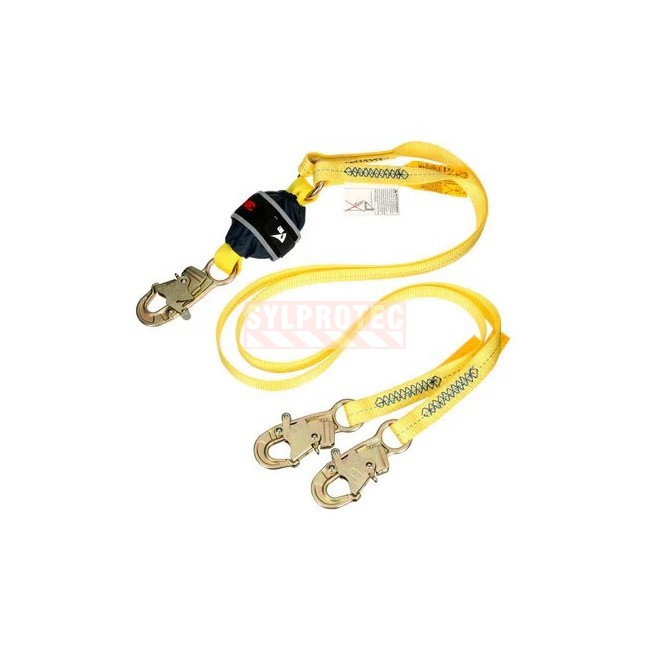
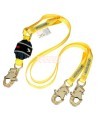
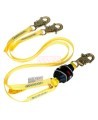
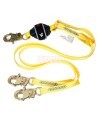
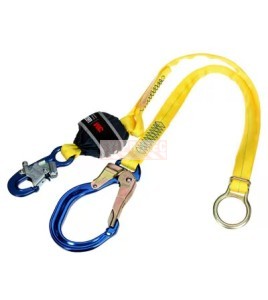
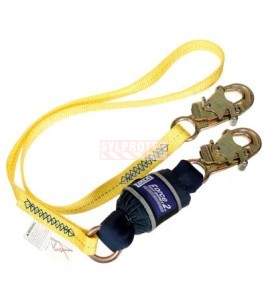
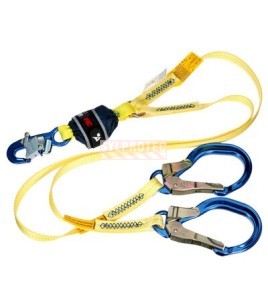
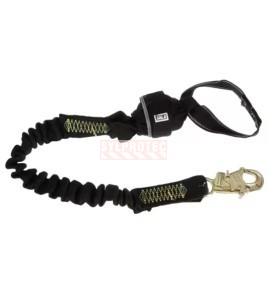
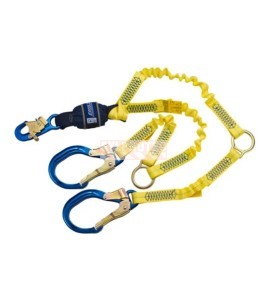
DBI-SALA 3M twin-leg Y shock-absorbing web lanyard with small spring-loaded snap hooks, available in 4 ft or 6 ft. Provides 100% tie-off to stay connected while moving between anchorage points.
No returnable if used. For more information about our return policy, please refer to the Orders and Returns.
| Length | Sylprotec code | 3M model | 3M purchase code |
|---|---|---|---|
| 4 ft (1.2 m) | FPL1246578C | 1246578C | 7100329196 |
| 6 ft (1.8 m) | FPL1246576C | 1246576C | 7100329194 |
This Y double-leg lanyard with a built-in energy absorber, available in 4 ft (1.2 m) or 6 ft (1.8 m), is designed for work that requires frequent moves at height, when a worker must travel from one anchorage point to another without ever disconnecting. Select the length from the drop-down menu on the page.
Its two-leg configuration provides 100 % tie-off: you connect the second leg to the new anchorage before releasing the first, so the worker stays connected at all times during transitions.
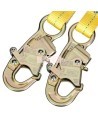
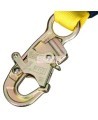
Each leg carries a self-locking, zinc-plated steel snap hook for quick, secure connection to approved anchorage points, while the common end attaches to the worker's harness.
For fixed single-anchor workstations, we also offer the (lanyard) version. That one-leg configuration suits restraint applications and work carried out at a fixed position.
In construction and industrial maintenance across Canada, fall prevention is a top priority. This double-leg lanyard links the worker to anchorage points while absorbing the energy of a fall. The internal energy absorber, featuring the 3M IRF system with controlled tearing, deploys gradually to reduce the arrest forces transmitted to the body. The DBI-SALA 3M range combines durability and reliability in a solution that meets the strictest safety standards.
Choosing this Y lanyard means investing in professional-grade equipment that puts continuity of protection first during moves. Its rugged polyester webbing resists abrasion and demanding work environments. Whether you work on towers, scaffolds or steel structures, this lanyard keeps you connected at all times.
Important note: In the event of a fall, the absorber deploys to limit the arrest forces on the body. Always engage the lanyard as intended so an absorber is in the load path during a fall.
With a single-leg lanyard, every change of anchorage forces the worker to disconnect, creating a brief moment without protection. The Y double-leg lanyard removes that risk: its two legs let you always keep at least one hook attached while you move the other. This is what we call 100 % tie-off, essential for climbing a structure, moving along a framework or crossing obstacles at height without ever losing the connection.
Connect the common end with the energy absorber to the dorsal D-ring of your safety harness. Then attach one leg to an approved anchorage point. When moving, first connect the second leg to the new anchorage, confirm it is locked, and only then release the first. Make sure the snap hooks are properly locked at every step.
Careful maintenance extends the life of your lanyard and keeps you safe. Before each use, inspect both legs of the webbing for cuts, burns or signs of excessive wear. Check that the self-locking snap hooks work properly. Clean the lanyard with lukewarm water and mild soap if soiled, and let it air-dry away from direct heat sources. Store it in a cool, dry place, away from UV rays and chemicals.
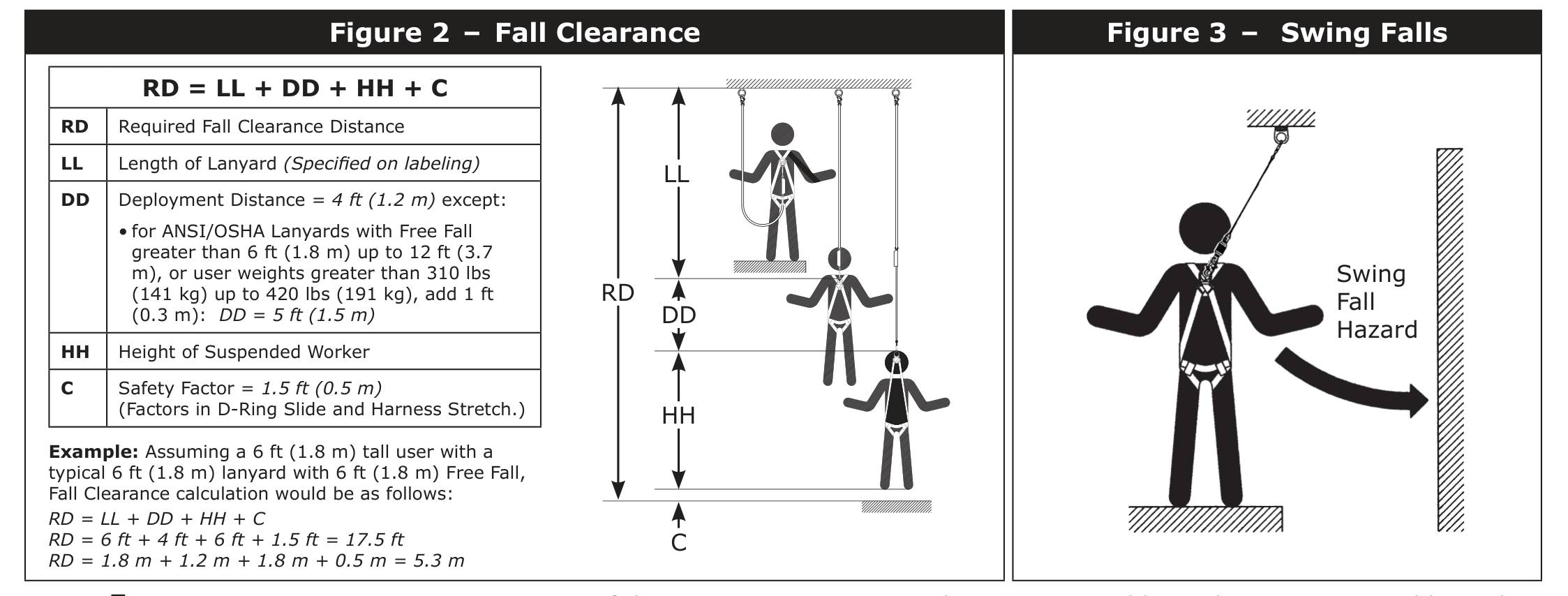
Before using this energy-absorbing lanyard, calculate the fall clearance, that is, the free space required below the anchorage point to arrest a fall before the worker strikes the ground or an obstacle. This clearance window adds up from several elements: the length of the lanyard, the deployment of the energy absorber, the height of the worker, the dorsal D-ring slide and a safety margin. A miscalculation is one of the most common causes of serious injuries at height, even with compliant equipment.
Example for the 4 ft model: the lanyard (4 ft) plus the absorber deployment (4 ft) plus the worker height (6 ft) plus a safety margin (1.5 ft) give a total clearance of about 15.5 ft (4.7 m) below an overhead anchorage.
Example for the 6 ft model: the lanyard (6 ft) plus the absorber deployment (4 ft) plus the worker height (6 ft) plus a safety margin (1.5 ft) give a total clearance of about 17.5 ft (5.3 m). In low-clearance situations, choose a self-retracting lifeline instead.
Yes, this product is certified to the CSA Z259.11 standard, ensuring compliance for construction sites and industrial environments in Canada.
This lanyard is designed for a worker whose total weight (including tools) is between 132 and 310 lb (59.9 to 140.6 kg).
The Y lanyard provides 100 % tie-off: its two legs let you stay connected at all times while moving between anchorage points, whereas a single-leg lanyard requires you to disconnect at each transition.
For the 4 ft model: the lanyard (4 ft) plus the absorber deployment (4 ft) plus the worker height (6 ft) plus a safety margin (1.5 ft) give about 15.5 ft (4.7 m). For the 6 ft model: 6 plus 4 plus 6 plus 1.5 give about 17.5 ft (5.3 m) below an overhead anchorage. In low-clearance situations, choose a self-retracting lifeline instead.
This is the most dangerous scenario (fall factor 2): the free fall can reach twice the length of the lanyard. This 3M IRF-system energy-absorbing lanyard is designed to dissipate the energy of a severe fall and reduce arrest forces, making it a suitable choice when the anchorage is at foot level.
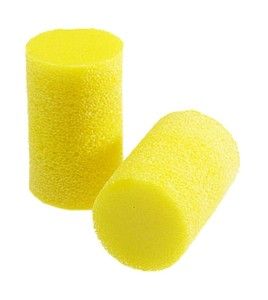
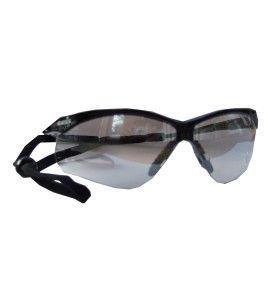
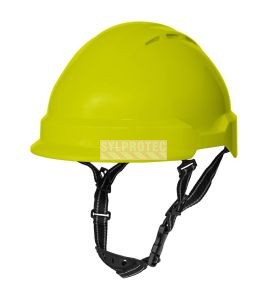
A roofer connecting with this DBI-SALA 3M lanyard completes personal protection with a high-visibility garment (VV20), a helmet (TA222) with an integrated chin strap, cut-resistant gloves (GS21TX), safety eyewear (YA3299) and corded earplugs (OA101) that stay around the neck and cannot drop from height.
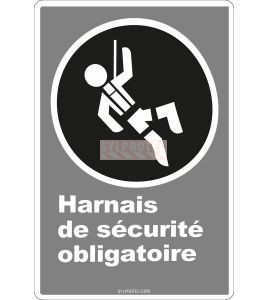
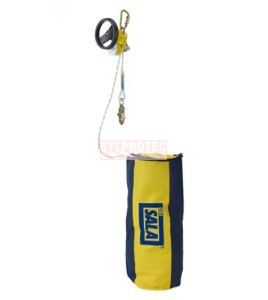
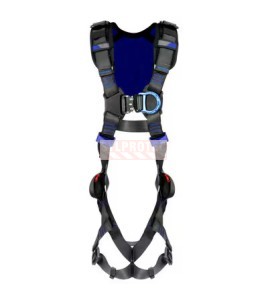
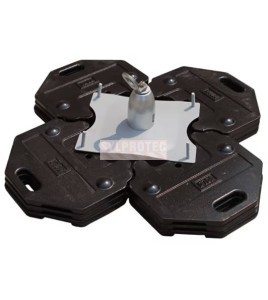
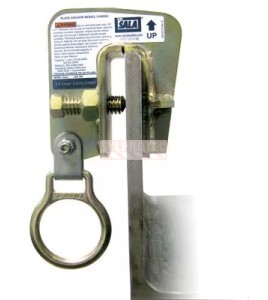
For the lanyard to work in a complete fall arrest system, plan a DBI-SALA 3M harness (FPH140323XCAL), a DBI-SALA 3M fixed anchor (FPA2100215), a second DBI-SALA 3M complementary anchor (FPA2104550), a 100 ft RollGliss R550 rescue (FPLR550) and descent device for emergency lowering, a DANGER barricade tape (ECT3RE9) to cordon off the ground area and the sign (ECO130) reminding that the harness is mandatory.

Data sheet
You might also like
DBI-SALA 3M twin-leg Y shock-absorbing web lanyard with small spring-loaded snap hooks, available in 4 ft or 6 ft. Provides 100% tie-off to stay connected while moving between anchorage points.