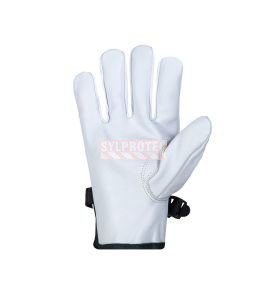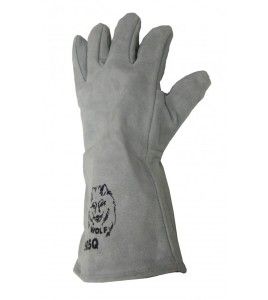
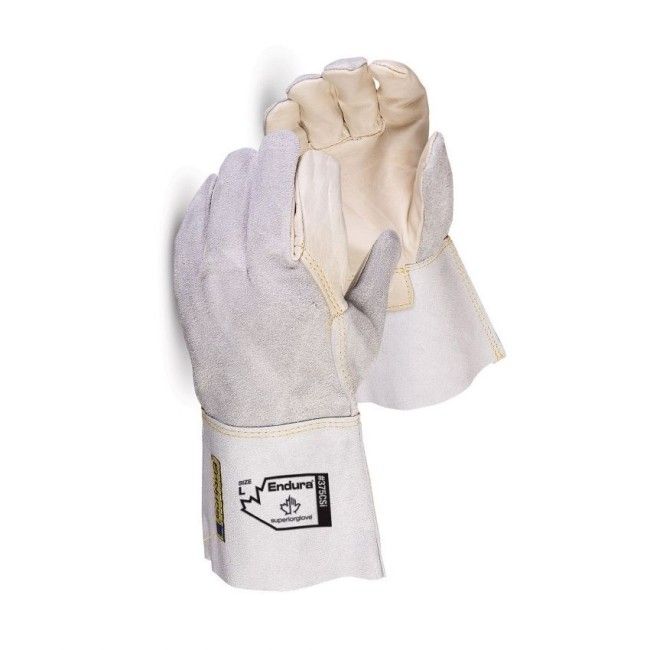
Side-split cowhide at the wrist and full grain leather at the palm welding glove, 11 in (28 cm) long, with wing thumb and leather welts, and a 4 in cuff protecting the forearm. Contact heat protection up to 350 °F (175 °C). Available from medium (8) to 2XL (11), sold in pairs.
This welding glove combines side-split leather around the wrist and full grain cowhide on the palm side, for a total length of 11 in (28 cm). Available from medium (8) to two extra-large (11) and sold in pairs, it features a wing thumb — an angled construction with no seams on the palm side to obstruct work or cause fatigue — for better flexibility, with seams leather-welted in critical spots for better durability. Not only does the leather protect hands against contact heat up to 350 °F (175 °C), but its 4 in (10 cm) cuff also protects much of the forearm.
This glove is made of side-split leather around the wrist and full grain cowhide on both the palm and back of the hand. It features a wing thumb, an angled construction with no seams on the palm side to obstruct work or cause fatigue, for better flexibility. Its one-piece back provides excellent protection against sparks, since there are no seams to burn. Seams in critical spots are leather-welted for better durability. The leather protects against contact heat up to 350 °F (175 °C), and the cuff protects much of the forearm.
Side-split leather comes from slitting thicker hides into two sheets: the surface of the skin, the finest part known as "full grain", is the real leather, as opposed to the subsurface known as "split-leather". Split-leather is quite resistant to abrasion but thicker, and may feature a more raw aspect with irregularities.
Full grain leather comes from the surface of the skin, the finest part, as opposed to the split-leather from the subsurface. Cowgrain is the most popular leather on the market since cowhide strikes a good balance of durability, dexterity, abrasion resistance and comfort, while remaining quite cost-efficient.
These gloves are recommended for light welding applications, but will not measure up to jobs such as work in smelting plants and steel mills.
Do not immerse this glove in water or any other boiling liquid, since it offers only limited protection against heat conduction. Even though leather provides good protection against heat, it does not rule out the risk of burns or other mechanical hazards.
Washing this glove is not recommended, since water and soap tend to rob leather of its natural oils, which makes it stiffen and become brittle. If the nature of your work requires washing them, we recommend dry cleaning.
Leather protects against contact heat up to 350 °F (175 °C).
It is available from medium (8) to two extra-large (11), sold in pairs.
The wing thumb improves dexterity (fewer seams), and the 4 in (10 cm) cuff protects much of the forearm.
It is recommended for light welding applications. It is not suitable for work in smelting plants or steel mills.
It is not recommended: water and soap remove the leather's natural oils and stiffen it. If needed, prefer dry cleaning.
To complete your safety equipment, see the 12 in side-split cowhide welding glove with wing thumb (G601), the 15 in Endura® leather welding glove lined with Kevlar (G603), the 18 in Endura® side-split cowhide welding glove with level 2 heat resistance (G600), the Endura® goatskin and Kevlar glove for welding (G625), the 17 in Cool Grip® Kevlar thumb-patch bakers mitt (G611) and the higher-level 12 in Cool Grip® Kevlar mitt (G610). Under "Accessories" at the bottom of the page, complete with the nylon bib apron covered with PVC (VT1285) and the Sentec safety eyewear with clear polycarbonate lenses (YA12E90801).
Data sheet
Specific References
You might also like