- New
This item is not kept in stock. Please allow 5 days for delivery.
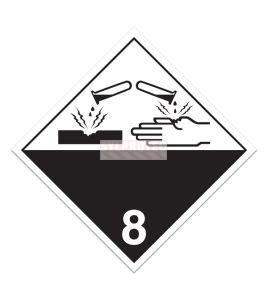
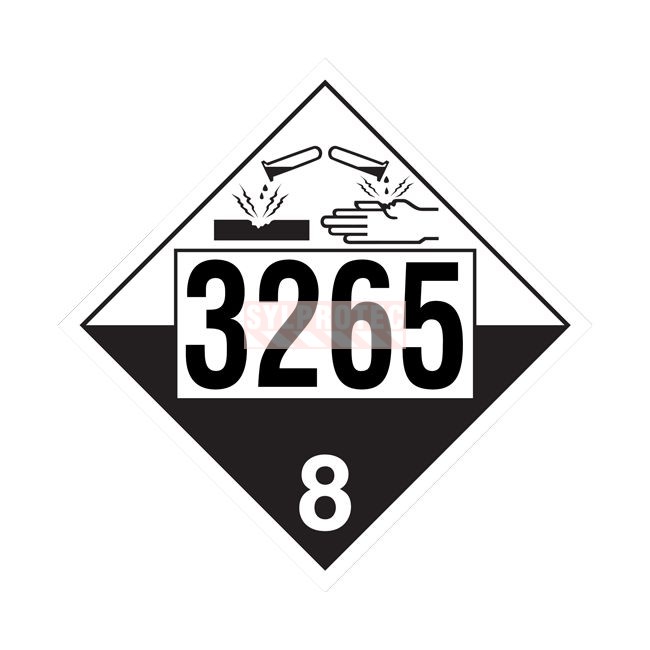
UN3265 placard for organic acids, class 8 corrosive substances: pre-printed number, the corrosive symbol and the class number 8, on a white and black 10-3/4 X 10-3/4 in diamond. Available in low-cost cardboard, reusable rigid plastic or self-adhesive vinyl for lasting application on a tank or trailer. Made in Canada and sold individually. Aluminum placard available on request: contact customer service for a quote.
No returnable if used. For more information about our return policy, please refer to the Orders and Returns.
This item is not kept in stock. Please allow 5 days for delivery.
The UN3265 placard identifies a load of corrosive liquid, acidic, organic, N.O.S., a class 8 substance, on trucks and tanks delivering chemical manufacturing products and process formulations. It shows the number 3265 in black in its white box, the corrosive symbol and the class number 8, on a white and black 10-3/4 X 10-3/4 in diamond that fits most placard holders. Made in Canada, it is sold individually.
| Material | Sylprotec code | Best use |
|---|---|---|
| Cardboard (tagboard) | ECLA3265-C | Low-cost option for temporary or one-time use |
| Rigid plastic | ECLA3265-P | Weatherproof and reusable in demanding conditions |
| Self-adhesive vinyl | ECLA3265-VY | Permanent application on tanks and trailers |
Aluminum placard available on request: contact customer service for a quote.
UN number 3265 corresponds to the shipping name CORROSIVE LIQUID, ACIDIC, ORGANIC, N.O.S., class 8, packing group I, II or III depending on the product. This generic entry covers organic acid preparations found in chemical manufacturing and process formulations; the acid and its concentration are on the safety data sheet. Transport Canada's 2024 Emergency Response Guidebook (ERG) places it under guide 153, for combustible toxic or corrosive substances: the product can cause severe burns and toxic effects, and heat can generate flammable vapours.
In case of a spill during transport or in your storage area, guide 153 calls for dialing 911, then the emergency number on the shipping document, and isolating at least 50 m around a liquid spill, increasing the protected area downwind as needed. Eliminate all ignition sources, do not touch damaged containers or the spilled product without appropriate protective clothing and, if you can do it without risk, stop the leak. Keep the acid out of waterways, sewers, basements and confined areas. Absorb or cover the liquid with dry earth, sand or another non-combustible material, transfer it into containers and keep water out of the containers.
Keep a mineral absorbent (ABGMM225) in the vehicle and near the storage area to cover the liquid, along with chemical socks (ABCB30) and pads (ABCT100) to contain the flow; check their compatibility with the product's safety data sheet.
The substance is combustible: it may burn without igniting readily, and its vapours, once heated, can form an explosive mixture with air. In a fire, it is often the vehicle, the packaging or nearby goods that burn, and heat can rupture containers and release corrosive or toxic gases. For both small and large fires, guide 153 names dry chemical and CO₂ among the agents: an ABC dry chemical (EXABC10) extinguisher or a CO₂ (EXCO10) unit is suitable. Place it in the vehicle cab and at an accessible spot near the storage area, outside the hazard zone. A fire that spreads is a job for firefighters; if a tank is involved, the guide calls for isolating 800 m in all directions and considering an initial evacuation over the same distance.
These guidelines from the 2024 ERG help you prepare your transport and storage procedures. For the exact product and the real situation, the current safety data sheet and the ERG prevail; emergency measures are for trained and equipped personnel, with a positive pressure self-contained breathing apparatus (SCBA), as the guide specifies.
The UN3265 placard is intended for chemical distributors, formulators and carriers shipping organic acids without a more specific shipping name. Cardboard is handy for a one-time load, rigid plastic is reused from one trip to the next, and self-adhesive vinyl stays in place on a tank dedicated to acids.
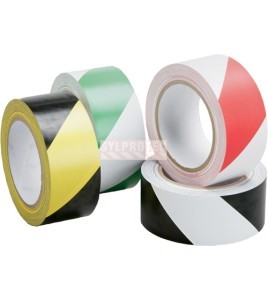
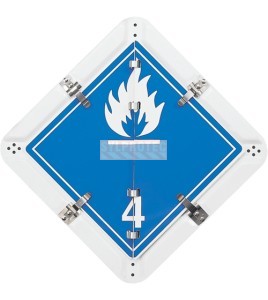
Complete your display with an aluminum flip chart placard, with five (ECLAP5) legends including class 8, or fourteen (ECLAP14) legends, for trucks whose cargo changes; the class 8 corrosive placard (ECLA8); and the yellow and black warning tape (ECT751JN108) to mark off the storage area.
| Feature | Detail |
|---|---|
| UN number | 3265 |
| Shipping name | CORROSIVE LIQUID, ACIDIC, ORGANIC, N.O.S. |
| Class | 8, corrosives |
| Packing group | I, II or III depending on the product |
| ERG 2024 guide | 153 |
| Dimensions | 10-3/4 X 10-3/4 in |
| Materials | Cardboard, rigid plastic or self-adhesive vinyl |
| Country of origin | Canada |
| Sold by | Unit |
Apply the self-adhesive vinyl to a clean, dry surface. Keep the placard clean so the number stays legible, and replace it if it is damaged, faded or illegible. For a placard exposed to the weather for a long time, choose rigid plastic or vinyl over cardboard.
Cardboard is the low-cost option for temporary use. Rigid plastic is weatherproof and reusable. Self-adhesive vinyl suits permanent application on a tank or trailer.
No: acetic acid has its own UN numbers in the TDG Regulations. UN3265 is used for organic corrosive acids without a more specific shipping name; check the shipping document.
Guide 153 of the 2024 ERG calls for isolating at least 50 m around a liquid spill and increasing the protected area downwind as needed. If a tank is on fire, isolate 800 m in all directions.
An ABC or BC dry chemical extinguisher, or a CO₂ extinguisher: guide 153 names them for both small and large fires. A fire that spreads is a job for firefighters.
Yes. Its 10-3/4 X 10-3/4 in format is the standard size that fits most placard holders.
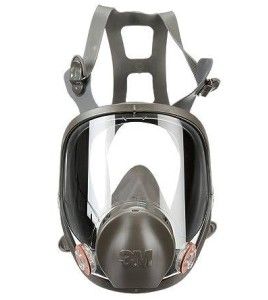
For the driver or handler who deals with the acid at loading, delivery or in the warehouse, plan for Centurion splash goggles (YG454), a 6000 series full face respirator (R6800) with combination organic vapour and acid gas cartridges (R60923), selected according to the SDS and the risk assessment, 12 in Chemstop neoprene gloves (GNE3030), waterproof PVC steel toe boots (VC18821C) and a flame-resistant high-visibility vest (VV510FR) to stay visible on the road and at the loading station.
To contain and respond to a spill, keep on hand sheets (ABCT100) for corrosive or hazardous chemicals, snakes (ABCB30) for these chemicals, a large 55 US gallon hazmat spill overpack (ABCE55), Magic Monkey mineral granules (ABGMM225), a 10 lb ABC dry powder (EXABC10) extinguisher, a 10 lb BC-rated (EXCO10) extinguisher and 28 in traffic cones (EPTCONE28B) to mark off the perimeter. For a driver working in isolation: the type 1 personal (TR01) first aid kit suits an isolated worker with no access to another kit, a vehicle with 1 to 5 workers, or a vehicle with more than 5 workers less than 30 minutes from medical services; for a vehicle with more than 5 workers more than 30 minutes from medical services, provide the type 2 basic (TR02M) first aid kit. Complete the truck's equipment with a portable road safety kit (TR16) and the set of three removable reflectors (EPTR) to signal a stopped vehicle.
Data sheet
You might also like
This item is not kept in stock. Please allow 5 days for delivery.
UN3265 placard for organic acids, class 8 corrosive substances: pre-printed number, the corrosive symbol and the class number 8, on a white and black 10-3/4 X 10-3/4 in diamond. Available in low-cost cardboard, reusable rigid plastic or self-adhesive vinyl for lasting application on a tank or trailer. Made in Canada and sold individually. Aluminum placard available on request: contact customer service for a quote.