

No returnable if used. For more information about our return policy, please refer to the Orders and Returns.
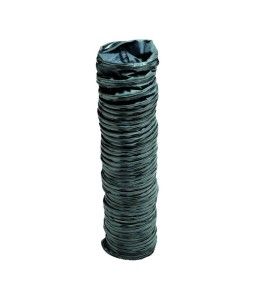
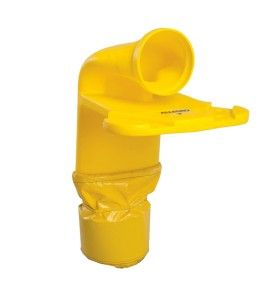
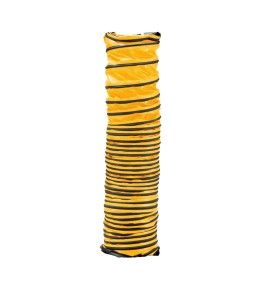
A 12" / 30.4 cm diameter explosion-proof axial blower designed specifically for purging and ventilating confined spaces in potentially explosive atmospheres. This kit includes a 12" diameter antistatic flexible duct measuring 25 feet / 7.62 m, stored in a removable rigid compartment attached to the blower by a quick-connect clip system. Depending on orientation, the blower can extract contaminated air (purge mode) or supply fresh air into the confined space (ventilation mode).
Allegro Industries manufacturer's code: 9548-25.
Meets Class I, Divisions 1 and 2, Groups C and D, and Class II, Divisions 1 and 2, Groups F and G requirements for hazardous locations. The single-phase electric motor is UL/CSA certified in explosion-proof configuration. This blower is intended for environments where flammable gases, vapours, or explosive dusts may be present — service pits, sewer manholes, industrial tanks, treatment stations, tunnels, and any other classified confined space entry.
In practice, contaminated gases are extracted first, then a reading is taken with a detector (DETEC4GC). If results are acceptable, the blower is reversed to supply fresh air into the confined space. Even after purging and ventilating, workers must continue to wear gas detectors at all times.
The housing is made of lightweight polyethylene, resistant to corrosion, UV light, and most chemicals. The blower features six polypropylene blades, a powder-coated steel grille, and a carrying handle moulded into the housing. The lower housing provides safe, convenient storage of electrical components. The manufacturer states in its manual that this unit is compact and relatively quiet; it nonetheless recommends wearing hearing protection for anyone near the blower.
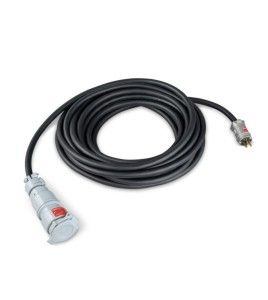
This blower uses a 115 V NEMA plug that must be connected to an explosion-proof socket (RA9503-03, sold separately). No standard receptacle is acceptable in a classified location.
By simply reversing the blower orientation, the operator switches between purge mode and ventilation mode — no tools or additional adjustments required. This versatility reduces the number of pieces of equipment to transport on site.
The motor and overall blower design meet the requirements for hazardous locations Class I (flammable gases and vapours) and Class II (combustible dusts), Divisions 1 and 2. This certification ensures the blower does not constitute an ignition source in explosive atmospheres.
The vinyl/polyester antistatic duct with Class 1 steel helix and a grounding wire at each end is designed to eliminate the buildup of electrostatic charges — a potential ignition source in a confined space containing flammable vapours.
The main housing is high-density polyethylene — lightweight and resistant to corrosion, UV radiation, and chemicals. The six blades are polypropylene, a durable, non-corrosive material. The flexible duct is made of antistatic vinyl and polyester, coated with neoprene for high-temperature resistance (up to 250°F / 121°C).
The manufacturer recommends positioning the blower more than 5 feet away from the manhole entrance. To choose the safest location, use wind direction to your advantage. During purge, position the blower and yourself so that fumes are dispersed by the wind without returning toward you. During ventilation, keep your back to the wind to avoid breathing the gas mixtures expelled from the confined space.
CAUTION: Explosion-proof blowers require an explosion-proof socket (RA9503-03), sold separately, for motors powered by 120 Volts AC, 60 Hz. Using a standard receptacle in a classified location is strictly prohibited.
After reviewing the instruction manual, we must provide additional critical information on grounding. When equipment is used in explosive environments, it is essential to ensure excellent grounding. The slightest spark can cause a disaster.
The explosion-proof ventilation duct has 1 grounding wire at each end. The manufacturer failed to clearly illustrate this in the product photos. One of these wires can be used to connect an additional duct of the same type to increase total duct length. To do this, use the galvanized steel connector (RACONN-12) and attach each duct grounding wire to the nearest end of the connector, so that the connector becomes part of the grounded assembly.
Furthermore, the instruction manual (page 7) states that the grounding wire of the duct (RA9550X-25) must be connected to a bolt located on the side of the blower chassis, a few centimetres from the grille. This connection ensures electrical continuity between the duct(s) and the blower.
To achieve a proper ground, all connected equipment must form a continuous electrical path leading to earth ground, with zero or very low ohmic resistance (especially important over long distances). A competent electrician must verify that the entire chain — duct end(s), blower, extension cords, explosion-proof socket, and electrical panel — is properly grounded.
In practice, decontamination companies often add a second safety ground. They wrap a conductive cable around the ventilation ducts, connect it to the motor chassis, and connect the assembly to a steel stake driven directly into the ground. This must also be performed by a competent electrician.
If you need to replace the duct, two lengths are available: 15 ft / 4.57 m (RA9550-15EX) or 25 ft / 7.62 m (RA9550-25EX).
To select the right blower for your specific confined space parameters (gas type, volume, number of duct elbows), Allegro Industries provides a user guide: https://www.allegrosafety.com/how-to-use-our-confined-space-blower-selector/, and a downloadable application for computer or smartphone: https://www.allegrosafety.com/blower-selector/.
A confined space may contain flammable gases, vapours, or combustible dusts. A standard fan can generate mechanical or electrical sparks capable of igniting these explosive atmospheres. An explosion-proof blower is specifically designed to eliminate all ignition sources: UL/CSA-certified motor, spark-free housing and blade materials, and antistatic duct. This is a regulatory requirement for Class I and Class II hazardous locations.
In a classified location, the entire electrical chain must be explosion-proof — including the receptacle. A standard socket creates a spark each time it is connected or disconnected, which is unacceptable in an explosive atmosphere. The RA9503-03 socket is sold separately because it is also compatible with other explosion-proof equipment powered at 120 V or 220 V.
The vinyl/polyester duct can accumulate electrostatic charges as air loaded with vapours flows through it. Without effective grounding, an electrostatic discharge can produce a spark — and trigger an explosion in a confined space containing flammable gases. Grounding must be verified by a competent electrician before each use in a classified location. The ohmic resistance of the entire chain (duct, blower, extension cord, socket, panel) must be zero or very low.
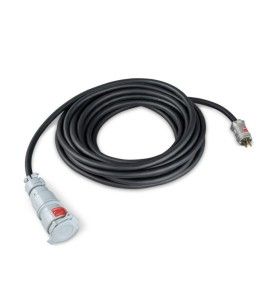
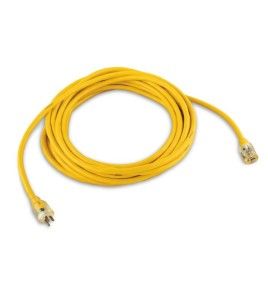
To complete your classified confined space equipment, start with the explosion-proof Allegro 110/220 V socket (RA9503-03) — mandatory for any explosion-proof blower —, the explosion-proof 50 ft 20 A extension cord (RA9540-50EX) to reach distant power sources, and the galvanized steel 12" connector (RACONN-12) for joining two ducts while maintaining grounding continuity. The replacement antistatic explosion-proof 12" duct (RA9550X-25) is also available separately. The MSA Altair 4X 4-gas detector with sampling pump (DETEC4GC) is essential for validating atmospheric safety before and during each entry.
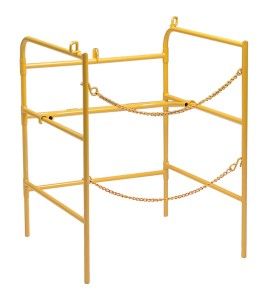
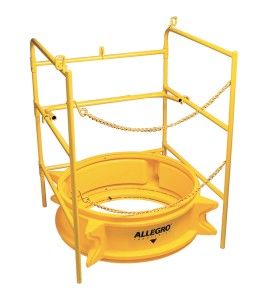
For worker safety when entering the confined space, the Peakworks 3-way confined space kit with winch (FPLRK3) and the Peakworks 6 D-ring class A/P/L/E harness (FPH2000APLE) provide regulatory fall protection. The manhole guard rail barrier (EPTBB) secures the access zone around the opening.
Data sheet
You might also like