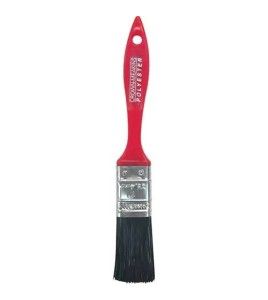
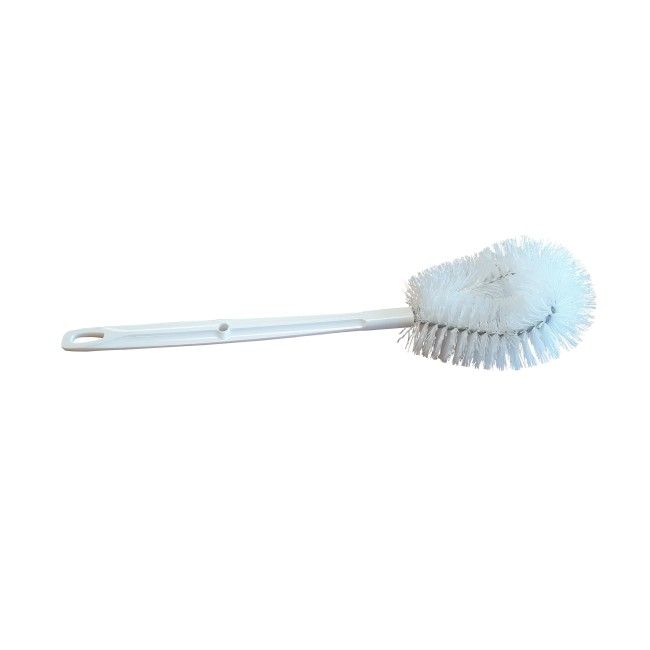
Optimize your asbestos decontamination operations with this polyester scrubbing brush designed for delicate pipes. This tool is essential for abatement professionals committed to meeting safety standards.
No returnable if used. For more information about our return policy, please refer to the Orders and Returns.
The polyester scrubbing brush is specifically designed for asbestos decontamination on delicate pipes. With its ergonomic handle and five rows of stiff bristles, it enables thorough cleaning without damaging sensitive surfaces. Used with a glove bag, it provides an effective barrier against asbestos fibers, reducing exposure risks for workers. This tool is sold individually, making equipment management easier on job sites.
For delicate jobs, the scrubbing brush is quite well-suited, since it has been designed for this purpose. For heavy-duty jobs, it is best recommended to use a scratch brush (see item (SAED6)) along with the scrubbing brush. Of course, any brush used to process asbestos, and any other tools, shall be decontaminated before being removed from the waste bag.
According to the Safety Code for the Construction Industry, chrysotile, amosite and crocidolite are the main types of asbestos found. Asbestos was a glorified material for its chemical and physical properties; it is as well a feared material for its pathogenic properties, hence the necessity to remove it properly.
The human health effects from long-term asbestos exposure are well documented, including asbestosis (a chronic disease) as well as lung cancer and mesothelioma (an aggressive form of cancer).
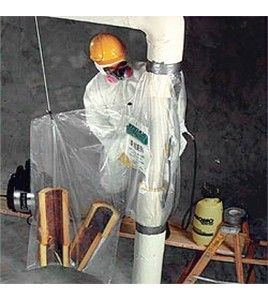
According to the ASP Construction (Health and Safety on Construction Sites) guide to the prevention on asbestos, the removal of this material on pipes shall be carried out using glove bags whenever the situation allows it.
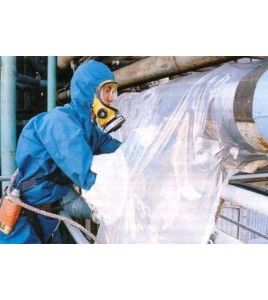
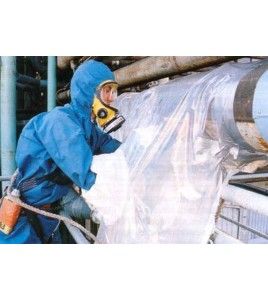
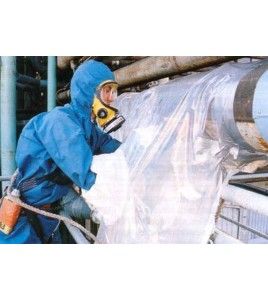
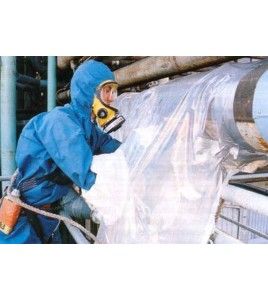
Using a glove bag to remediate asbestos insulation on pipes as by far the most effective method. Indeed, processing asbestos with a glove bag means the job to be done poses a moderate risk regardless of the amount of junk created since the work zone is concealed and the respiratory zone is isolated.
Such a method prevents having to comply with many burdensome safety measures required whenever workers have to be exposed to a high-risk work site, in this case, a site where a volume of more than 0.03 m3 of debris will be generated.
This process enables one to remove the asbestos insulation on pipes by simply leaving it in a sealed bag be it on horizontal or vertical pipes of various sizes, on valves, on joints, etc.
This scrubbing brush features an ergonomic plastic handle for comfortable grip. Its stiff polyester bristles are grouped into five rows to maximize cleaning efficiency. It is ideal for reaching complex areas such as valves or pipe joints. Its design allows safe use in confined environments, especially with a glove bag for asbestos decontamination.
To install the scrubbing brush in a glove bag, simply insert it through the designated opening, ensuring the bag is properly sealed around the pipe. The tool can then be handled through the glove bag sleeves to perform cleaning. This method maintains a physical barrier between the operator and contaminated materials, in accordance with safety protocols.
After each use, the scrubbing brush should be inspected for wear on the polyester bristles. If it has not been directly exposed to asbestos fibers, it can be cleaned with a suitable disinfectant solution. In case of contamination, it must be disposed of according to hazardous waste management procedures. Following these steps ensures worker safety and compliance with current standards.
During asbestos decontamination on delicate pipes, it is recommended to saturate materials with a wetting agent before cleaning. The scrubbing brush effectively removes residue while limiting fiber dispersion. Always use the tool inside a sealed glove bag and wear appropriate personal protective equipment. This method is especially suitable for interventions in restricted access areas.
The brush is equipped with stiff polyester bristles, grouped in five rows for effective cleaning.
It is designed for use with a glove bag to ensure optimal protection against asbestos fibers.
If the brush has been exposed to asbestos, it must be disposed of as hazardous waste according to decontamination standards.
Need additional safety equipment? See the articles; Safety hard hat (TA14LR), Omega II minor hard hat type 1 (TA14FS), motorized respirator with 1000 protection factors (R6800PF), 3M mask protection film (R6885).
Under "Accessories" at the bottom of the page. If you're looking for work equipment, have a look at the following products: White antistatic coveralls with (V51), containment fabric (SACTT2) or (SAH2MA) air cleaners.
Data sheet
You might also like
Optimize your asbestos decontamination operations with this polyester scrubbing brush designed for delicate pipes. This tool is essential for abatement professionals committed to meeting safety standards.